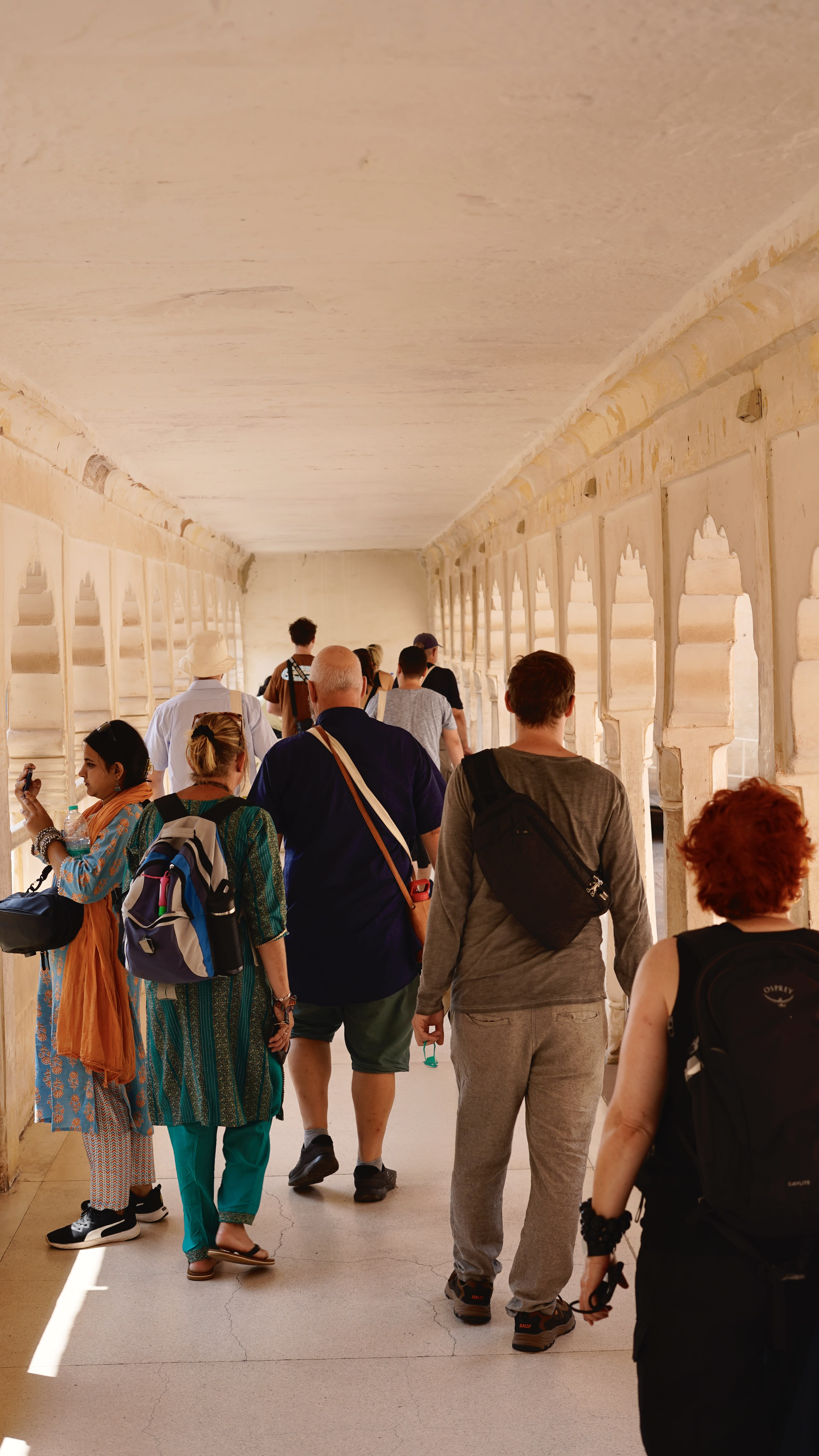
How Much Cash Should You Carry in India?
A practical breakdown of how much cash to carry in India, what to pay by card, and how to avoid ATM fees on a group trip.

On this page
If you're flying in from the US, UK, EU, or Australia, one of the most common pre-trip questions we get is how much cash to carry in India. The honest answer is: less than you'd think, but enough that you're never caught scrambling for small notes at a temple, a tuk-tuk, or a roadside chai stall. Here's a realistic, experience-based breakdown so you can land relaxed instead of anxious about money.
Quick answer: Carry roughly USD 150-250 worth of Indian rupees in cash per person for a two-week trip, withdraw the rest from ATMs as you go, and pay by card wherever it's accepted.
How Much Cash You Actually Need Per Day
Most of our travellers are surprised by how far cash goes for the small, everyday things that cards simply can't cover.
- Street food and small cafés — ₹100-400 (roughly USD 1-5) a day if you're sampling local food, chai, and snacks
- Tuk-tuks, local rickshaws, and short taxi hops — ₹200-600 (USD 2-7) a day depending on how much you're moving around a city
- Temple donations, shoe-keeper tips, and small vendors — ₹50-200 (USD 1-2) here and there
- Tipping guides, drivers, and hotel staff — this adds up over a trip, so budget separately (see our guide on money and tipping in India)
- Souvenirs and bargaining at markets — cash gets you better prices in most bazaars, especially in Jaipur's markets
As a rule of thumb, budget USD 15-25 in cash per day for a comfortable trip where hotels, bigger restaurants, and larger purchases go on card.
Cash vs Card: What Actually Works Where
India has moved fast on digital payments, but the split between cash and card is very location-dependent.
- Card works well at hotels, chain restaurants, malls, larger shops, and most tourist-facing businesses in Delhi, Agra, and Jaipur
- Cash is essential for local markets, street vendors, small family-run dhabas, auto-rickshaws, temple offerings, and tipping
- UPI (India's QR-code payment system) is everywhere, but it typically requires an Indian bank account or phone number, so it's not usable for most international visitors
- International cards with no foreign transaction fees (many US and UK travel cards now offer this) are your best friend for bigger spends
If you're doing a structured circuit like the Golden Triangle, you'll find Delhi, Agra, and Jaipur increasingly card-friendly, but keep cash ready for the in-between moments.
Where to Get Indian Rupees
You legally cannot buy rupees at your home bank before departure in most countries — the currency isn't freely traded outside India — so plan for on-arrival exchange.
- Airport ATMs on arrival — the easiest option; rates are fair and it's the safest way to get your first cash
- Bank ATMs in the city (HDFC, ICICI, SBI, Axis) — generally reliable, often better fee structures than random exchange counters
- Authorised money changers in tourist areas — convenient but check the rate and commission before handing over cash
- Avoid airport currency exchange counters for large amounts — the rates are usually worse than ATMs
Most international debit and credit cards work fine in Indian ATMs, but call your bank before you leave to flag international use, and check what they charge per withdrawal.
ATM Withdrawal Limits and Fees to Expect
This is where a bit of planning saves real money and hassle.
- Most Indian ATMs cap withdrawals at ₹10,000-15,000 per transaction (roughly USD 120-180), even if your daily limit is higher
- Your home bank may also charge a flat foreign ATM fee (often USD 3-5) plus a currency conversion fee (1-3%) on top
- Some banks charge per-withdrawal fees regardless of amount, so fewer, larger withdrawals usually cost less overall than frequent small ones
- Keep a backup card in a separate bag in case one gets blocked for "suspicious activity" — a quick call to your bank usually fixes this
Staying Safe With Cash
Carrying cash sensibly is part of general trip safety, not a separate worry.
- Split your cash between a day bag and a hotel safe rather than carrying it all at once
- Keep small denominations (₹10, ₹20, ₹50, ₹100 notes) handy — many vendors and rickshaw drivers can't break large notes
- Avoid flashing large amounts of cash in crowded markets or train stations
- If you're travelling solo, our guide on solo travel in India has more specific advice on money and safety habits
On a small-group trip with Chalo Folks, Anna and the group leader are usually on hand to help with change, local rates, and knowing which vendors prefer cash — one more reason travellers tell us small groups feel easier than going it alone.
Frequently Asked Questions
How much cash should I carry in India for a two-week trip?
For a typical two-week trip, plan on carrying the equivalent of USD 150-250 in Indian rupees at any given time, topped up via ATM withdrawals as you go. This covers daily small expenses like food, transport, and tips, while bigger costs go on card.
Can I exchange US dollars or British pounds for rupees in India?
Yes, dollars, pounds, and euros can be exchanged at banks, authorised money changers, and airport counters, though airport rates are usually the least favourable. It's generally cheaper to withdraw rupees directly from an ATM using a fee-free international card.
Do I need cash for the Golden Triangle (Delhi, Agra, Jaipur)?
You'll need cash for markets, rickshaws, small eateries, and tipping, even though hotels and bigger restaurants across Delhi, Agra, and Jaipur widely accept cards. Budget cash separately for each city rather than assuming one big withdrawal will cover the whole circuit.
What's the best way to avoid ATM fees in India?
Use a travel-friendly debit or credit card that waives foreign transaction fees, and make fewer, larger withdrawals rather than many small ones since many banks charge a flat fee per transaction. Stick to bank-branded ATMs (HDFC, ICICI, SBI, Axis) over standalone kiosks for better reliability and rates.
Ready to Plan Your India Trip?
Getting the money logistics right is one small piece of a much bigger, more rewarding puzzle — and it's a lot easier with a host who's done this dozens of times before. Browse our small-group, personally hosted itineraries at /destinations and see which trip fits your dates; Anna and the team handle the on-ground details so you can focus on the experience, not the exchange rate.
Keep reading
More guides to help you plan the same trip.
Currency, ATMs & Exchanging Money in India
Everything on currency exchange in India for visitors — using ATMs, whether to bring cash, avoiding poor rates, and how much to carry day to day.

Money & Tipping in India: A Tourist's Guide
A practical guide to cash, cards, and tipping in India so you know exactly who to pay, how much, and when.
Best SIM Card & eSIM for India in 2026 (Tourist Guide)
Which tourist SIM or eSIM to buy for India, where to get it at the airport, what it costs, and which network actually works outside the cities.

How Much Does India Cost Per Day? Real 2026 Numbers
What India actually costs per day for shoestring, mid-range and comfortable travellers — accommodation, food, transport and sightseeing.

How Much Does a Trip to India Cost? A 2026 Budget Breakdown
What two weeks in India really costs in 2026 — flights, visa, hotels, food and transport — plus how a small-group trip compares.

How Much Does a Yoga Retreat in Rishikesh Cost?
A clear, honest breakdown of yoga retreat Rishikesh cost, from budget ashrams to small-group trips, so you can budget in USD before you book.