Hampi Travel Guide: India's Ancient Ruins
A complete Hampi travel guide for US, UK and Europe travellers — the boulder-strewn ruins of Vijayanagara, top temples, how long to stay and when to go.
On this page
Few places in India feel as otherworldly as Hampi, and this Hampi travel guide is here to help travellers from the US, UK, and Europe make sense of it. Once the capital of the mighty Vijayanagara Empire, it's now a vast UNESCO World Heritage landscape where 15th-century temples, palaces, and bazaars sit among a surreal sea of giant granite boulders. It's part archaeology, part fever dream — and utterly unlike anywhere else in the country.
Quick answer: Hampi is the ruined capital of the Vijayanagara Empire in Karnataka, a UNESCO-listed site of temples and boulder-strewn landscapes. Two to three days lets you see the main monuments across both riverbanks. The best time to visit is October to February, when the weather is cool and dry.
What Hampi Actually Is
At its peak in the 1500s, Vijayanagara was one of the largest and richest cities in the world. It was sacked in 1565 and left to the elements — which is why you can now wander freely among the bones of an entire imperial capital.
- The site sprawls over more than 25 square kilometres.
- Ruins are split by the Tungabhadra River into the temple-rich sacred centre and the royal centre with palaces and enclosures.
- It rewards slow, curious exploration far more than a quick tick-list visit.
If you're weighing a southern add-on against the classic north, our North vs South India guide is a good place to start.
The Must-See Monuments
You can't see everything, so prioritise these:
- Virupaksha Temple — the still-active heart of Hampi, with its towering gateway (and a resident temple elephant).
- Vittala Temple — the icon of Hampi, home to the famous stone chariot and musical pillars.
- Hemakuta Hill — a cluster of shrines and the best sunset viewpoint.
- Royal Enclosure & Lotus Mahal — elegant palace architecture and the stepped Pushkarani tank.
- Elephant Stables — grand domed chambers that once housed the royal elephants.
- Achyutaraya Temple and the Sule Bazaar — an atmospheric, less-visited complex where you can wander an ancient market street almost alone.
Hampi is one of India's most photogenic destinations, so pack accordingly — our India photography tips will help you make the most of the golden-hour light on the boulders.
Getting Around the Ruins
The site is large and split by the river, so plan your transport:
| Option | Best for |
|---|---|
| Bicycle | Fit travellers exploring the sacred centre |
| Moped/scooter | Covering more ground independently |
| Auto-rickshaw (half/full day) | Comfortable, guided-style touring |
| Coracle boat | Crossing the river to the north bank |
Hiring a rickshaw for the day, with a driver who knows the layout, is the easiest way for most visitors — our getting around India and hiring a driver in India guides cover the etiquette and rough costs. The area straddling the river is a place to tread lightly, too; see responsible travel in India.
Best Time to Visit
Hampi's climate is a major factor in enjoying it:
- October–February: cool and dry, with comfortable days around 25–30°C (77–86°F) — the ideal window.
- March–May: very hot, often above 38°C (100°F); exploring open ruins is punishing.
- June–September: monsoon greenery and a fuller river, but humidity and some rain.
For how this fits the wider calendar, see our best time to visit India overview and month-specific guides like India in October and India in November.
Where Hampi Fits Your India Trip
Hampi pairs naturally with a broader South India route — many travellers combine it with the palace city of Mysore (see our Mysore travel guide) and the coast. That "ancient sites then beaches" rhythm is exactly the arc we build into our southern-leaning departure.
Our [Beyond Golden Triangle: Goa Edition, 16–26 October 2026](/destinations/beyond-golden-triangle-oct-2026) follows India's headline cultural sights with a relaxed coastal wind-down — hosted personally by Anna, capped at 12 travellers, and priced at $1,349 in USD for international guests. It's the easiest way to see India's ancient and coastal sides without wrestling with the logistics yourself.
Practical Notes
- Getting there: the nearest railhead is Hospet (Hosapete), about 30 minutes away; overnight trains and buses connect from Bengaluru and Goa.
- Where to stay: Hampi Bazaar (temple side) is central; Virupapur Gaddi across the river is the mellow, backpacker side.
- What to pack: sun protection, sturdy shoes, and plenty of water — see what to pack for India.
- Respect the site: it's sacred and protected — don't climb on carvings.
Frequently Asked Questions
How many days do you need in Hampi?
Two to three days is ideal. Two full days let you cover the sacred centre, the royal enclosure, and the Vittala Temple without rushing, while a third gives time to explore the quieter north bank and simply soak up the landscape.
What is Hampi famous for?
Hampi is famous for being the ruined capital of the Vijayanagara Empire, a UNESCO World Heritage Site of temples and palaces set among a dramatic landscape of giant granite boulders. Its stone chariot at the Vittala Temple is one of India's most iconic sights.
What is the best time to visit Hampi?
October to February is best, with cool, dry weather ideal for exploring the open ruins. Avoid the peak summer months of March to May, when temperatures regularly exceed 38°C (100°F) and sightseeing becomes uncomfortable.
How do you get around Hampi?
Most visitors hire an auto-rickshaw for a half or full day, which is comfortable and covers the spread-out site efficiently. Bicycles and mopeds suit independent travellers, and a coracle or ferry crosses the river to the quieter north bank.
Ready to See India's Ancient and Coastal Sides?
If Hampi's boulder-strewn ruins and a beach finish both appeal, our [Beyond Golden Triangle: Goa Edition, 16–26 October 2026](/destinations/beyond-golden-triangle-oct-2026) joins great culture with a coastal wind-down in one small group — hosted by Anna, priced in USD for international travellers. Explore more dates on our destinations page.
Keep reading
More guides to help you plan the same trip.

Jaisalmer Travel Guide: The Golden City & Thar Desert
Jaisalmer for US, UK and Europe travellers: the living fort, the havelis, camel safaris in the Thar Desert, when to go and how long to stay.

Mumbai Travel Guide for First-Time Visitors
Mumbai for US, UK and Europe travellers: the big sights, colonial architecture, street food, safety, and how many days you need.
Udaipur Travel Guide: India's City of Lakes
Udaipur for US, UK and Europe travellers: the best sights, when to go, how many days you need, and how to slot the City of Lakes into a trip.
10 Days in India: The Perfect First-Timer Itinerary
A realistic 10 days in India itinerary for first-timers, covering Delhi, Agra, Jaipur, and Rishikesh without the rush.
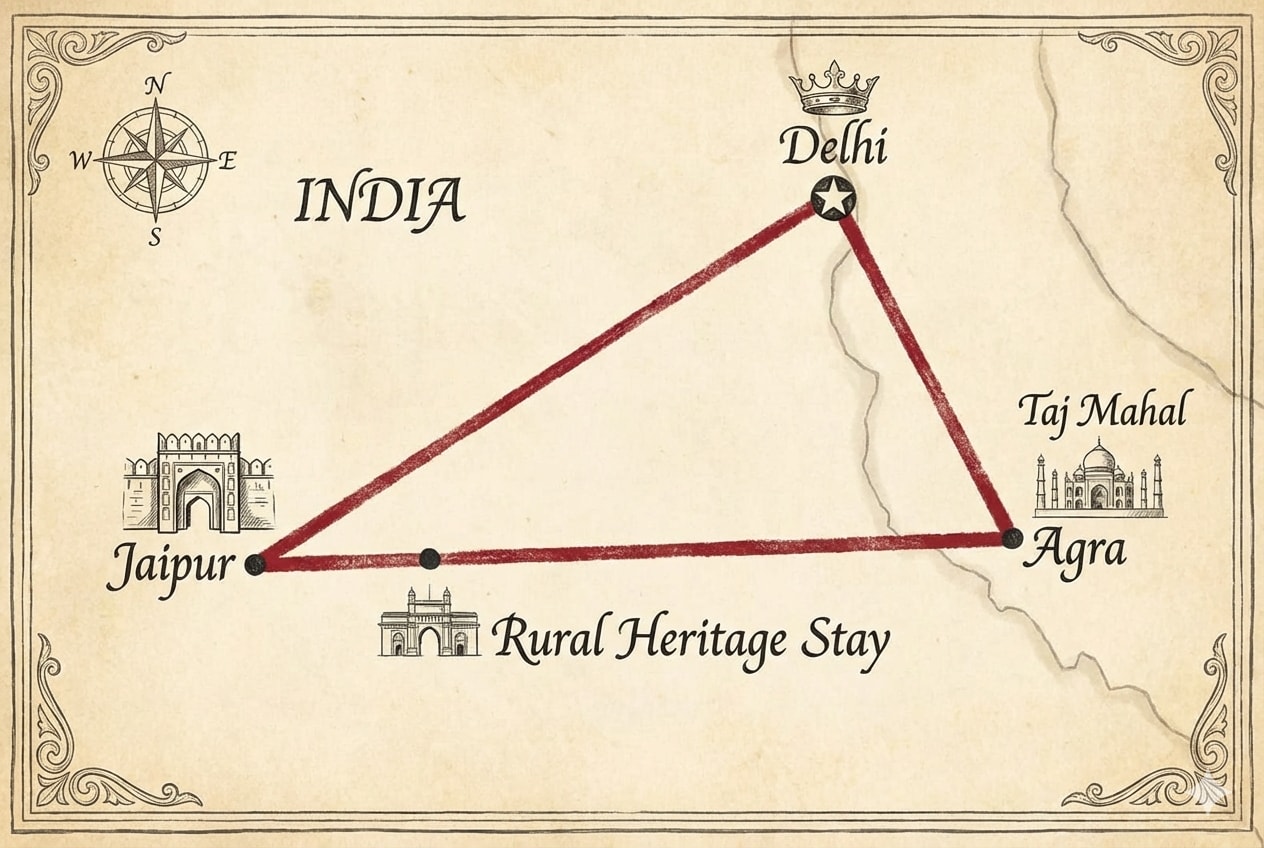
Golden Triangle Itinerary: How Many Days Do You Need?
Three days or ten? An honest day-by-day look at how long Delhi–Agra–Jaipur really takes, and the itinerary that does it justice.
McLeod Ganj & Dharamshala: Little Tibet in the Himalayas
McLeod Ganj and Dharamshala for US, UK and Europe visitors: the Dalai Lama's home town, monasteries, the Triund trek, and when to go.